Related Links and Pages from Other Sources

Showing posts with label baltic. Show all posts

Tuesday, July 14, 2026

July: Another month of two baronial newsletters

In the wee hours of Saturday the 11th, I finished the July issue of the Drekkar, the baronial newsletter. (Yes, I know I should italicize it, but I'm too lazy.) It's due between the 25th of the previous month (in this case, June) and the 5th of the current month (July), so this issue was late. However, I've been late multiple times and the Kingdom Chronicler hasn't said boo about it. (Sssh!)

Since there is no baronial business meeting this month, and therefore no meeting notes to publish, I thought I'd do a bare-bones newsletter for August and publish it on July 25, when I leave for Pennsic. However, I was just informed this weekend that the Baronial Letters of Intent NEED to be published in the Drekkar by July 25. (I guess I should heed what I've already published!)

So that's just one more thing I have to do before leaving for Pennsic ... on July 25.

Here is the "to-do" list as it currently stands:

  • Write two short freelance articles for pay
  • Pack everything I could possibly need for two weeks at Pennsic (which probably means drawing up a fresh packing list to keep track of all the stuff)
  • Buy odds and ends that I need for Pennsic (fresh batteries, non-perishable food, etc.) 
  • Sew some new garb that is in progress
  • Get some stuff together for the Slavic Interest Group meetup at Pennsic
  • Pay a couple of bills that can't wait until after Pennsic
  • Put the August Drekkar together and send it out
  • Download the music I need for either the Known World Choir or the Pennsic Broken Consort (or both!) and practice it
  • Warp up my inkle loom with the next Baltic pickup pattern I want to try
  • Attend one more Laydes Fayre rehearsal
  • Keep the appointment with the cardiologist (who had better NOT tell me that I shouldn't go to Pennsic)
  • Write a note to my editor about the freelance feature article I will be working on between August 10 and September 30
  • Pick up a bin or two of stuff for the Children's Fete from our Youth Officer and bring it to Pennsic with me

Plus all the usual stuff of day-to-day living (cooking dinner, doing laundry, serving as the timer for the Greenbelt Toastmasters Club meeting, yadda yadda). 

Monday, January 5, 2026

Another new year

I hope all who read this are enjoying the new year, despite any upsetting mundane news. Each January is like a shiny new penny before it accumulates all the scratches from circulation.

As I said in my last post, I want to spend this year -- in which the SCA will celebrate the 60th anniversary of its founding -- documenting exactly what I do within the context of the Society, both in terms of arts & sciences and of service. My first idea was to make weekly posts, but when I told this to one of my friends, she said that might prove to be too much of a burden. So ... twice a month? We'll see how that turns out. If I stick to that schedule, that will make the most posts on this blog since 2009.

So, here we go.

Service as chronicler: The Drekkar, Storvik's newsletter, is due out on the 5th of each month. So I'd better finish up the January issue. I've got all the materials for it. At some point I will make a special memorial issue for Baroness Gracie. But I also need to earn some freelance money to keep my head above water.

Service in heraldry: I need to recruit some teachers for the Tri-Kingdom University session that is rapidly approaching. 😱

Musical arts: Dance practice resumes tonight after a couple of weeks off for the holidays. Laydes Fayre continues to rehearse for two upcoming events, one at the Lochmere Midwinter Revel on the last day of this month and another at Kingdom Arts & Sciences Festival (KASF) in March. The Laydes primarily sing, of course, but some of us play musical instruments, so we're rehearsing an instrumental cantiga for the Lochmere revel. I play soprano recorder semi-competently; recently I was given a used alto recorder, so I should try to learn that too. But someone else has already claimed the alto recorder part for this cantiga, so I'll play soprano melody. No big deal. It's a simple piece.

Tangible arts: I have warped my inkle loom for a second Baltic pick-up band. (Woven band, NOT musical band!) One of these days I'll have to write an entire post about Baltic pick-up weaving, but this is not the time for it. I am also planning what to wear to Highland Hearthglow later this month. Some alterations are in order, and maybe one new thing, but I don't have time to create an entirely new outfit from the inner layers out.

I think that's it. For now. 

Monday, April 15, 2019

This year so far, part 1

We're now more than three months into 2019. So far I've been to a a couple of baronial business meetings and a few SCA events in other Maryland baronies (Lochmere and Bright Hills, specifically). At the end of March I attended an unofficial event, Storvik Performers' Revel, which is intended to be by and for performers to show off their skills in a relaxed setting (and to eat the food produced by a couple of talented chefs).

At the beginning of January, I marked the 15th anniversary of my first SCA event: Storvik Yule Revel 2004. That day I met so many people for the first time ... and, strangely enough, quite a few of them are still in my life today. I am definitely grateful for how those people have enriched my life.

This has been another one of those seasons in which Their Majesties Atlantia have seen fit to bestow some long-delayed Peerages and Orders of High Merit (Grant of Arms level) on people who should have received those awards in the past, but didn't for whatever reason. My friend Janina Krakowska, one of our former Baronesses of Storvik, received her well-deserved Laurel for embroidery; my friend Sonya Flicker, who organized the 2017 Known World Dance and Music Symposium, was inducted into the Order of the Golden Dolphin for service; and another longtime Storvik and Southwind friend, Tirzah MacCrudden, was elevated to Laurel at Ymir in February.

Also, Baron Stefan of the Barony of Black Diamond became a Laurel in dance, Baroness Wynne became a Pelican, and a longtime scribe, Baroness Daniela, became a Laurel for calligraphy and illumination. I could go on and on....

On the personal front, I've been plugging away as a freelance writer, so I'm not rich by any means, but this year may end up a bit more remunerative than the last. (*crosses fingers*)

In the news I've found a couple of items of interest to the Baltic region. First of all, a 5,000-year-old barley grain was found in what is now Finland. So people were doing at least some rudimentary farming in that area back in that time, not just killing and eating seals and fish.

The other news item garnered more press coverage than the little detail about ancient barley. The Smithsonian Channel showed an hour-long documentary on scientists who studied Casimir Pulaski's bones and concluded that he may have been an intersex person. Casimir Pulaski was, of course, the Polish nobleman who crossed the ocean, proved his cavalry skills to George Washington, got promoted to brigadier general, and was killed in Savannah, Georgia. (Pulaski's birthplace, Warsaw, was still part of the Polish-Lithuanian Commonwealth when he was born in 1745, so Lithuanians could theoretically claim him as well.) Pulaski has long been a hero to Polish Americans; when I was a kid, my neighborhood in my Massachusetts hometown had a Pulaski Playground, though I didn't learn about the origin of that appellation until I was a bit too old for the playground equipment.

Apparently, when Pulaski's bones were disinterred so that his memorial could be rebuilt, anthropologists found that his skull and pelvis were shaped more like a woman's than a man's. It took a while, but finally the bones were confirmed to be Pulaski's through a mitochondrial DNA match with his grand-niece. His baptismal record suggests he was "debilitated" (or something like that in Latin), so he may have had congenital adrenal hyperplasia (CAH), which would have made his body produce excessive androgens despite female chromosomes. (I'm using male pronouns because he was raised as a male and probably considered himself completely male. Given the relative status of the genders for most of European history, it's not surprising that he was designated male, even though he might not have looked like a "regular" baby boy inside his diaper.)

In addition to the Smithsonian Channel show, the research was covered in the Washington Post and the Guardian, among other media outlets.

One final note: Thanks in part to a post in the Kingdom of Atlantia's unofficial Facebook group, I've been finding a lot more SCA-related blogs, so that they don't all fit in the Blogroll anymore. I'm going to start a separate page for lists of blogs and other interesting websites. That will be a work in progress, so please don't expect it to look organized right away.

Thursday, November 6, 2014

Links and more links!

Recently I have been exchanging Facebook messages about medieval Baltic topics with a couple of my Slavic Interest Group (SIG) friends, Mistress ffride (Kingdom of Lochac) and Lady Magdalena (Kingdom of Aethelmearc). As a result, I have lots and lots of browser tabs open. Before my computer's memory gets tied up in knots, I really ought to save those links somewhere and close those tabs. What better place to save such links than right here?

Without further ado:

Link that mentions the Gediminas Sceptre in the context of Baltic cosmology. I really wish this page provided some sources.

Academia.edu page for a Lithuanian graduate student in archaeology. Her name is Augustina Kuriliene.

A Vilnius museum's exhibit on Grand Duke Alexander.

History of the palace of the Grand Dukes of Lithuania.

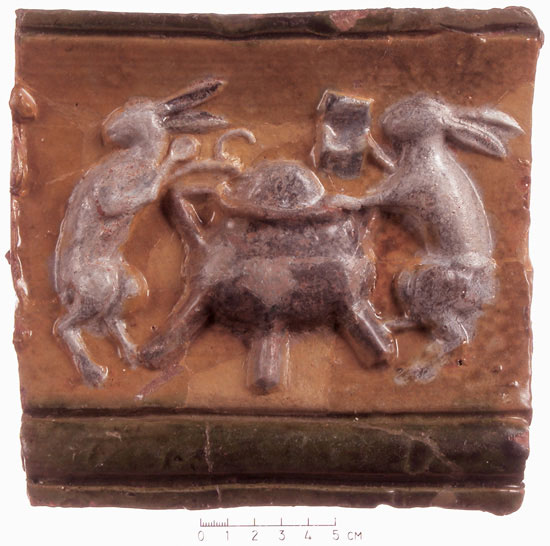
Some tiles from a cathedral (in Lithuanian). One of those medieval tiles shows a woman wearing what may be a very tall, flat-topped hat. In another tile, two rabbits seem to be consulting a recipe book while cooking a stew. In a third tile, two rabbits appear to be roasting a human chef over a spit. (Revenge of the bunnies!!)

PDF of a 2003 article on Lithuanian archaeology by Daiva Steponaviciene.

Website of some Lithuanian group called Vita Antiqua (I believe Daiva S. is involved with it).

This page seems to list all the commemorations of Lithuanian historical events that will take place in 2015.

Evidence of Lithuanian platform shoes. (Somebody wanted to look taller!)

Another 16th-century tile, this one showing rabbits fending off the hounds. (Somebody really, really liked bunnies!)

Finally, here are a few links that are not specific to the Baltic and Slavic regions but that I find interesting anyway:

The Tudor Tailor website is a companion to the series of books on 16th-century clothing.

Free, downloadable monographs on various topics pertaining to English archaeology.

A Web page on inkle weaving.

Beautiful clothing that one of my friends made for the Baron and Baroness of Dun Carraig (a nearby SCA branch).

And, finally, did you know that there's an authentic butterbeer recipe from the Tudor era? Now you can combine your SCA brewing with your Harry Potter fandom! :-)

As far as the rest of my SCA life goes, well, things are always quieter this time of year. Earlier this fall I skipped a couple of SCA events that I really would have liked to attend because of cash-flow issues. At least I had great fun participating in a "medieval maker faire" demo that Storvik was invited to organize as part of the University of Maryland at College Park's celebration of the 60th anniversary of the publication of Lord of the Rings. This fall Storvik has been welcoming a number of newcomers, both from the university and the region at large. And our barony is planning a performing-arts event in January 2015. And I'm still knitting socks for Lady Sonya's sock classes. So things are quiet but good.

Thursday, August 19, 2010

Back from Pennsic

Greetings to all!

On Sunday the 15th I traveled home from a very enjoyable Pennsic War XXXIX, where I taught two sessions of my Battle of Grunwald class and one session of "Survey of Modern Lithuania," which was essentially the same class as this.

Right now I'm just posting a short note to remind my students -- especially my students in the Grunwald class, who got just a one-page handout due to my pressing personal issues prior to Pennsic -- that I haven't forgotten about you and I'll try to get this information up as quickly as possible.

In the meantime, blogger Cathy Raymond ("Loose Threads") has posted a review of the first chapter of Medieval Clothing and Textiles 6, edited by Robin Netherton and Gale R. Owen-Crocker (not "Owen-Crocke" as the cover says!). That first chapter presents a survey of Latvian clothing and textiles from the seventh to the 13th centuries, all based on archaeological findings. Granted, the essay is about Latvia and not Lithuania, but there is some overlap. In particular, I did not realize from other sources that the soil gets slightly different as you move south through the Baltic region, so that scraps of fabric are found in Latvian digs but not in Lithuanian sites. I don't know exactly what creates the change in soil composition, but it does seem to have an effect.

Hmm. Maybe the class I would really like to teach in the future, "Lithuanian Women Through the Ages," will have to become "Lithuanian and Latvian Women Through the Ages." But that is an issue for another day.

Thursday, July 15, 2010

SIX HUNDRED years ago today...

As I said to a co-worker this morning, "How cool is it that we know that something big happened exactly 600 years ago today?" (OK, I'm ignoring differences between the Julian and Gregorian calendars here.)

I'm looking for online news of the commemorations. I hesitate to say "celebrations" today because, although the victory at Grunwald/Zalgiris was A Big Deal for Poland and Lithuania, an awful lot of human beings lost their lives that day. I grew up in a community of 20,000 people, so if you estimate the total toll of that battle at 12,000 to 13,000, then it's almost like two-thirds of my hometown vanishing in a single day. That's a lot of blood.

But back to the news....

PressEurop.eu calls Grunwald "the battle that changed Central Europe." Belarus Digest claims that most of the Lithuanian units at the battle were from lands that are now part of Belarus and that the Belarusian president was not invited to the official commemoration "for obvious reasons." (Jealous much?) Expatica.com takes a look at the reenactors.

For a more Lithuanian perspective on the anniversary, check out this article (in Lithuanian) and especially the miniature version of the battle created by a Vilnius museum. An English-language article appears here. (It's a bit difficult to search Google News for "Zalgiris" because the name is so big in basketball.)

Since the New York Times did such a detailed writeup of the 500th-anniversary commemoration of Grunwald, I was a bit miffed that the publication did not mention it on its "On This Day" page today. After all the things that happened in the last 90 years of the 20th century, one could argue that it's even more important today to remember Grunwald than it was in 1910.

Finally, thanks to Wikipedia (which *did* mention Grunwald on ITS "on this date" page), I finally found the official website for the 600th anniversary. It's offered in six languages -- including Belarusian. (Ha!) Some of the historical articles contain interesting ideas, which I must study in preparation for my Pennsic classes.

Monday, June 28, 2010

Early-summer update

Whew, it's mighty hot and humid here in the USA's capital city, and I'm thinking Pennsic -- what about you?

Currently I'm reading a book called The Baltic Revolution: Estonia, Latvia, Lithuania and the Path to Independence by Anatol Lieven. It was originally published right after the events of 1990-1991, so it's actually got a bit of a dated feel to it -- it would be interesting to read whether the author's initial hunches were borne out over time. I suspect that Algirdas Brazauskas, the first post-Soviet president of Lithuania, plays a pretty big role in this book -- I just learned from Wikipedia that he died a couple of days ago. (You'd never know that from the American media.)

Although most of the history outlined in Lieven's book is way past the SCA's time period, the author keeps placing the more recent events in the context of the cultural history (both real and imagined) of each of the three Baltic nations. Personally, I'm glad to know about this, if only to answer the question of "why do we care at all about Lithuania?"

In other post-SCA-period news, Wikipedia tells us that today is the anniversary of the Battle of Berestechko, which seems to have primarily involved folks from present-day Poland and Ukraine, even though it took place during the era of the Polish-Lithuanian Commonwealth.

Friday, April 23, 2010

Drinks & clothing & stuff

Photos are still forthcoming. I actually didn't take many photos at Slavic University because I was busy doing other things. You can go to the photo gallery mentioned at the end of the previous entry if you really are curious. Most of the pictures I've still got on my memory card are of various steps in the process of making five margučiai last month.

Yesterday someone asked me (on my LiveJournal account) whether I'd been able to find any documentation that Lithuanians made and drank krupnikas in period. Krupnikas, of course, is that dense honey liqueur that Sfandra was offering to fellow Slavik University attendees.

I responded with various links that I picked up from various Web searches. To summarize, I found some online claims that Lithuanians invented krupnikas during the SCA period, without any evidence to back it up, and I also found claims that viryta (another variation on the honey-liqueur theme) was dreamed up by Lithuanian-Americans in Maryland and Pennsylvania.

As I told my correspondent, I have a hard time believing that the immigrants of a century ago invented honey liqueur out of the clear blue sky. I suspect it was a recreation of something they had drunk back in their homeland. (And of course, all the recipes for krupnikas and viryta are a little different from each other, because families individualize the stuff the way they do with meatloaf, spaghetti sauce, and whatnot.) Now, there is no guarantee that Lithuanians were drinking that stuff back in the Middle Ages and Renaissance -- a lot of "folk music," "folk dress," "folk dancing," etc. turns out to be way post-period. (Side note: I have no idea whether this honey krupnikas is at all related to Polish raspberry krupnik, which is basically berries marinated in vodka.)

I can't resist delving into all things Lithuanian, so I decided to do a little Web surfing to check out some of the claims in one of the articles. Long story short, I ended up on a Web site with high-resolution scans of the city maps from the multivolume atlas Civitates orbis terrarum, published between 1572 and 1617. It turns out that collaborators Georg Braun and Franz Hogenberg included Vilnius in the third volume of the atlas (1581). Here's what their bird's-eye view of Vilnius looked like:


Now, at this point in my research I'm not so worried how the streets were laid out -- I'm much more interested in the people in the foreground. The site "Working-Class Images" has a close-up view of the man and woman in the center of the foreground. At last -- a period idea of what very ordinary people looked like, not just the fancy Elzbieta and Barbora! Something I might actually be able to sew for myself with my limited skills, too.

The map of Riga, Latvia, also published in 1581, has much less detailed images of people -- nothing for the clothier to take note of there. However, the map of Gdansk from the second volume of the atlas (1575) has several women in the foreground. Their gowns look more detailed and seem to have more German influence than their Lithuanian cousins, but again, they look like ordinary folk and not royalty.

I'm really, really glad I found these resources, because even though I can buy a pattern to make a Cranach-style gown, modifying it and encrusting it to look something like this portrait of Barbara Radziwill would be a bit beyond my skill level. Now I can set some realistic garb-creation goals.

Saturday, December 19, 2009

Baltic-style provisioning

Ah, where to get Eastern European food without spending all that money on airfare and hotels? Wouldn't it be great to have a listing of stores and restaurants that provide such tasty ethnic victuals?

Disclaimer: The following is not a commercial endorsement. I'm simply pointing out a few food sources that I know of.

Not far from Storvik, I've found the Kielbasa Factory in Rockville, Md. LOTS of varieties of frozen pierogies and other treats. Plenty of candy and canned goods imported from Poland. Some of these things are Polish specialties; others are simply food products you can get elsewhere, but with Polish-language labels. I think the people who run the store are natives of Poland, too.

Also in Rockville, plus two other sites in northern Virginia, is the Russian Gourmet. I haven't had a chance to check it out yet, but I hope to do so in the new year.

In my hometown of Gardner, Mass., Bonk's Market is still in business. I know, "Bonk's" isn't much of a Slavic name, but when I was growing up, it was the place to go for Lithuanian "white" (i.e., not smoked) kielbasa and fresh rye bread. (My hometown has even more French Canadian Americans than Polish Americans -- that's why Bonk's also serves up poutines rapées at this time of year.) I haven't been to Bonk's in years, but when I'm in Massachusetts next week, I'll have to check it out!

In the Boston area, the purveyor of Eastern European groceries seems to be the Baltic European Deli not far from Andrew Square. I've never been there, but maybe I ought to check it out on a future trip.

Finally, I stumbled upon PolishPlate.com, a Web site that lists lots of Polish shops and restaurants around the U.S. Of course I can't vouch for its completeness. Mostly, I'd like to hear from other Slavic Interest Group members, SCA folks, and re-enactors who can suggest food-related business they're familiar with.